Rinat Goren: Encaustic Painting and the Shape of a Thought
Each studio day for Rinat Goren begins the same way: she turns on the hot plate. Encaustic paint is pigment suspended in beeswax, and until it melts, nothing can happen. While the wax warms, she reads the notes she left herself the day before on a scrap of paper, and picks up exactly where the work stopped.
It is a patient rhythm for a painter whose real subject moves very fast. From her studio in Woodside, California, Goren makes abstract encaustic paintings that try to give thought itself a visible shape. She describes the work in three words: connectivity, contemplative, joyful.
Seven days without sleep
Goren grew up in a household where things were made by hand. "We stitched, mended, painted, decorated and built with our own hands," she remembers, "so the language of creating was familiar." Even so, she spent years setting the urge aside. Self-expression never came easily to her, and it was only later in life that she discovered art was the clearest way to say what she values.
The turning point arrived sideways. Asked to help decorate the offices of a biotech startup, she spent about seven days painting almost without pause. "I was euphoric," she says, "did not sleep and could not stop." By the end she knew this was the work she needed to do, and she changed course at once. Her professional practice began in 2008.
Why beeswax
Her early paintings were in acrylic and collage, and something was missing. She wanted layers with real depth, and acrylic kept flattening them. Then another encaustic artist introduced her to the medium, and she "immediately fell for it."
Encaustic is among the oldest painting techniques in existence: molten wax, colored with pigment, brushed on warm and fused with heat, one thin layer at a time. Because beeswax is translucent, light travels down through the surface, and the eye follows it into the layers below. In person, Goren's paintings have a silky, luminous skin that photographs never quite capture. Up close, the history of every pass of wax is still there.

Geometry, chaos and the look of a thought
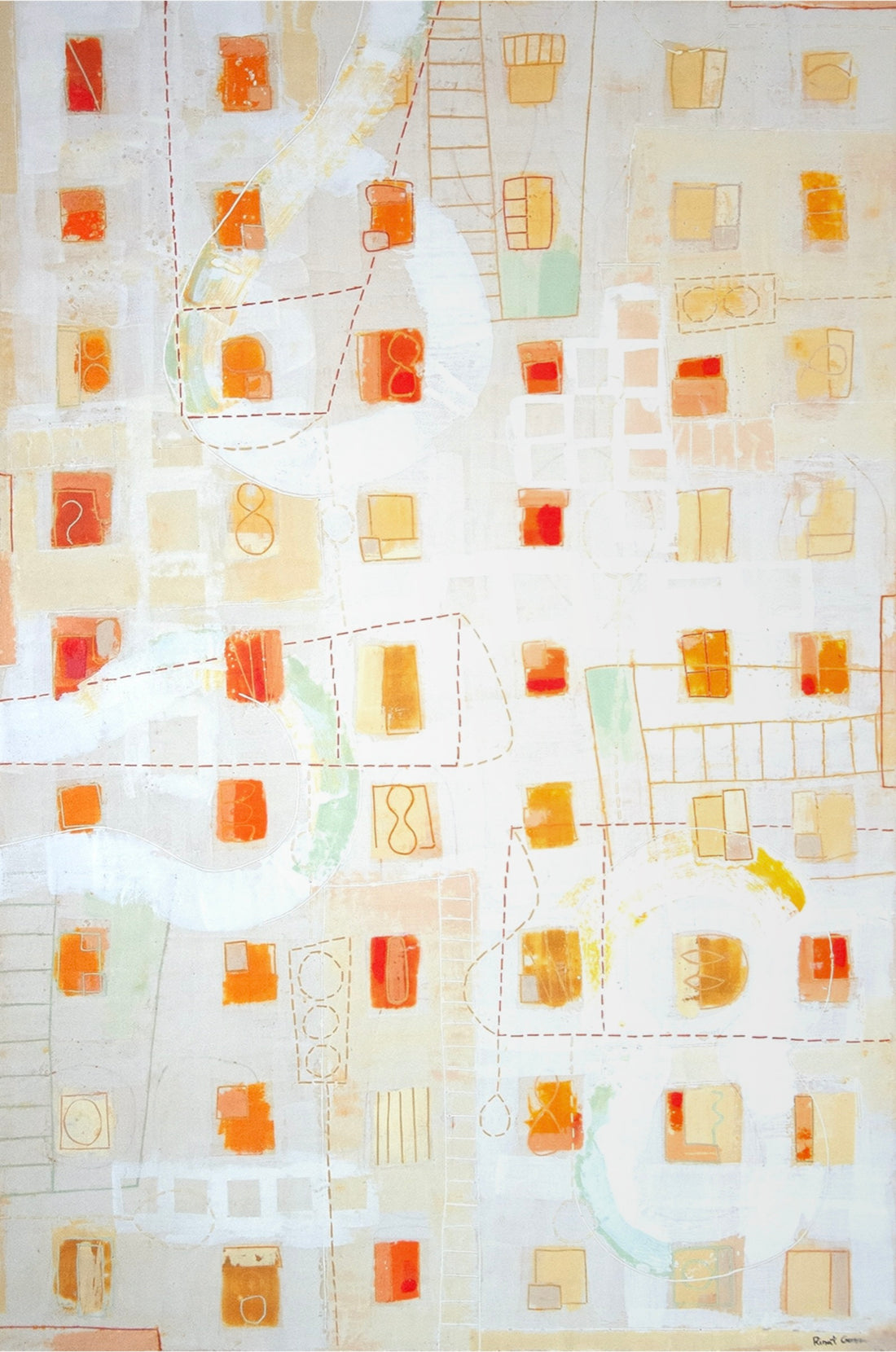
"My work is mostly abstract," Goren explains, "and it is an attempt to convey and celebrate our unique ability to think and to reason. It is a balanced mix of geometry and chaos and it is typically colorful and playful."
She is moved by the human capacity to reason, to solve problems and to invent, and by the people around her who are, in her words, "great thinkers." Matisse, Calder and Klee left their mark on her, along with the local artists she sees every day. On the panel, grids, circles and ladders of small marks behave like ideas taking form: orderly, then interrupted, then connected again. The titles say as much, from Signs & Languages to Windows of Opportunity and Wrapped In Thoughts III.
Ideas arrive from "tiny moments of light, color or pattern." A pencil sketch comes first, sometimes a small study, then the full panel, and now and then a whole series. She often works with an audiobook or podcast playing, and she always stops to look at a piece from across the room before deciding what it needs. Some days that looking takes longer than the painting, and a new panel gets started instead.
A Moment of Joy

Asked which of her paintings means the most to her, Goren chose A Moment of Joy. Rows of small circles drift across warm bands of orange, coral and pink, threaded together by fine vertical lines, while a few yellow forms link the circles like beads on a string.
"This piece is a celebration of our ability to live well," she says. "Our ability to be grateful for small moments of beauty, decisions we make and moments of connections." She made it out of a need to bring joy into her own life, as a counterweight to "negativity, animosity and irrationality." What surprised her was how it felt to paint: "The unexpected was the sense of joy and gratitude that I felt while painting it."
Calm light, restless world
Goren counts herself fortunate to have a beautiful, light-filled studio and a safe place to work. She is also very aware of the conflict in the culture around her. "These opposites create tension that affects me deeply and leads me to create," she says.
That tension is now becoming a subject of its own. She is developing a new body of work around the idea that opposites attract, and spending more time on fiber art, a thread that runs back to the stitching and mending of her childhood. She will also take part in a large encaustic exhibition at an art center in Redwood City. Past solo exhibitions include a presentation at the Peninsula Museum of Art in Burlingame.

Living with an encaustic painting
For Goren, a painting is not finished when it leaves the studio. She describes collecting as the close of a circle that begins with her at the hot plate and ends with someone who connects with the work and chooses to live with it. "It is a very meaningful, satisfying and confirming experience for me as an artist." Her hope for each collector is simple: that the painting "brings a moment of joy every time they look at it."
Encaustic is also a practical medium to live with. Once cooled, the wax surface is stable and needs no varnish or glass. Hang it away from direct sun and strong heat sources such as a fireplace mantel, dust it gently with a soft cloth, and, over time, a light buff with a lint-free cloth will bring back its soft sheen.
Explore available encaustic paintings by Rinat Goren, including Evolving, her largest work with Art Scout, and the luminous We Are So Much More. Her work also appears in our mixed media collection, and collectors can commission a work shaped around their own space.
---
Art Scout is an online contemporary art gallery based in Monterey, California, representing internationally exhibited and museum-collected artists from around the world. Through exhibitions, art fairs, and thoughtful digital presentation, Art Scout connects collectors with original works distinguished by strong visual language, material sensitivity, and contemporary relevance.